Chapter 1
Exploring the Investigative World of Science
Curiosity Book - Detailed Notes
Welcome to the World of Scientific Investigation
Science is all around us! It starts with simple questions like "Why?" and "How?" about everything we see in our daily life. In Grade 8, we will not just learn facts - we will learn how to find new facts through investigation.

Investigation in science means asking focused questions, designing simple experiments to answer those questions, and using observations to improve our understanding.
The Spirit of Curiosity
Every great scientific discovery began with curiosity. When we wonder about things like:
- Why is one side of a puri thinner than the other?
- Are there more grains of sand on Earth or stars in our galaxy?
- Why has nature created such vast variety in plants and animals?
These questions spark our journey into the investigative world of science.
Our Scientific Journey This Year
This year, our adventure will take us from tiny microbes we can't see to planet-wide challenges we can't ignore. Let's explore the amazing stops on our journey:
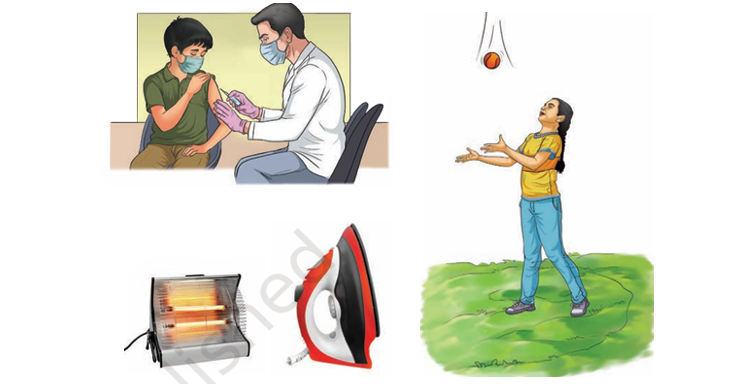
Microorganisms
Hidden world in a drop of water - helpful and harmful tiny organisms
Health & Nutrition
How our body stays healthy and fights infections
Electric Current
How electricity makes our lives easier through heating and magnetic effects
Forces & Motion
Understanding why things speed up, slow down, or change direction
From Particles to Weather
Understanding Pressure and Forces
Forces don't just affect moving objects - they also create pressure. The same concepts that explain why a ball falls to the ground also help us understand:
- How air moves and creates breezes
- Why strong pressure differences cause cyclones
- How weather events affect our daily lives
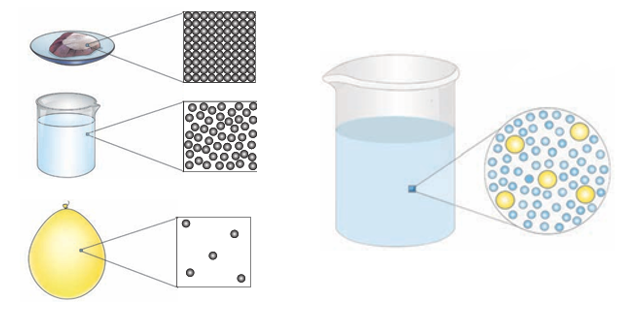
The World of Tiny Particles
To truly understand how air creates pressure or why water boils, we need to zoom into materials and see what tiny particles they're made of.
We can classify all materials around us into:
- Elements: Pure substances (like oxygen, gold)
- Compounds: Two or more elements bonded together (like water H₂O)
- Mixtures: Combinations that can be separated physically (like salt water)
Light, Mirrors, and the Moon
How Light Behaves
Light is fascinating! It can:
- Reflect off flat and curved mirrors
- Bend when passing through lenses
- Help us understand how glasses help people see clearly
- Explain why we see different images in a shiny spoon
The Moon's Phases
Even rough surfaces reflect light - including the Moon! Depending on the positions of Earth, Moon, and Sun, different parts of the Moon are illuminated each night. This creates the beautiful phases we see.

Ecosystems and Earth's Perfect Balance
Complex Relationships in Nature
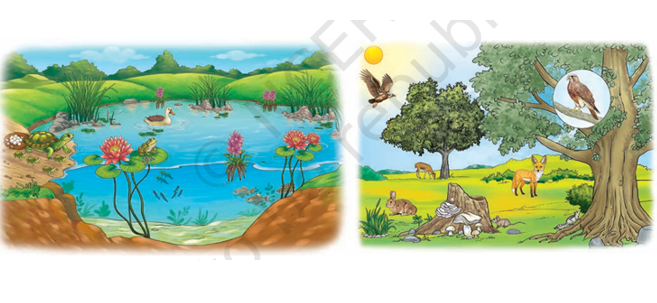
Right here on Earth, there are amazing patterns of relationships between living organisms and their environments. Every living being - from the tiniest insect to the largest whale, from grass to tall trees - depends on:
- Air and water
- Sunlight
- Other organisms around them
These form the ecosystems that support all life on our planet.
Why Earth is 'Just Right' for Life
Earth has perfect conditions for life:
- Perfect distance from the Sun where water stays liquid
- An atmosphere that provides oxygen
- Protection from harmful ultraviolet rays
Thinking Like a Scientist: The Puri Investigation
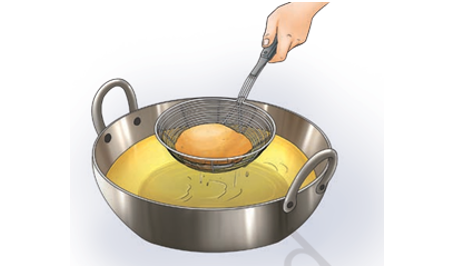
Let's learn how to investigate like a real scientist using an everyday example - Why is one side of a puri thinner than the other?
Step 1: Ask a Scientific Question
What are the different things that may change the way a puri puffs up when fried?
Step 2: Identify What We Can Control
Things we can change in our experiment:
- Thickness of rolled dough
- Size of the dough
- Type of flour (atta, maida, etc.)
- Temperature of oil
- How we drop the dough into oil
Step 3: Decide What to Observe
Things we can measure or observe:
- Does the puri puff up? (Yes/No)
- Time taken to puff up (in seconds)
- Whether thick dough still gives a thin side
- Any sounds, smells, or other observations
Key Learning Points
The Scientific Method
- Observe: Look carefully at what happens around you
- Question: Ask "Why?" and "How?" about your observations
- Experiment: Design simple tests to find answers
- Record: Keep notes of everything you see and sense
- Analyze: Think about what your results mean
- Question Again: New answers often lead to new questions
Science is Everywhere
You don't need a fancy laboratory to do science. Your kitchen, your backyard, even your daily observations can be starting points for scientific investigation. All you need is curiosity and careful observation.
Practice Questions
Objective Questions
a) To memorize facts
b) To ask focused questions and find answers through experiments
c) To read textbooks
d) To copy from others
Explanation: Scientific investigation is about actively discovering new knowledge through systematic questioning and experimentation.
a) Changing only one variable at a time
b) Keeping detailed notes
c) Changing multiple things simultaneously
d) Making careful observations
Explanation: To understand cause and effect, scientists change only one variable at a time while keeping other conditions constant.
a) Two
b) Three
c) Four
d) Five
Explanation: Materials are classified into elements, compounds, and mixtures.
a) Only its size
b) Perfect distance from Sun, liquid water, and protective atmosphere
c) Only its atmosphere
d) Only its distance from the Sun
Explanation: Earth's habitability depends on multiple factors working together.
a) Move around freely
b) Cannot move much
c) Are not present
d) Move faster than in gases
Explanation: In solids, particles are tightly packed and can only vibrate in their positions, unlike in gases where they move freely.
Subjective Questions
Variables to Control: Use same flour, same oil temperature, same size dough circles
Variable to Test: Thickness of dough (make some thin, some thick, some medium)
What to Observe: Whether puri puffs up, time taken to puff, thickness difference between sides, any patterns
Reliable Results: Repeat experiment multiple times, change only one variable at a time, keep detailed notes of all observations including sounds and smells, test with different people to confirm results.
Elements: Pure oxygen (O₂) for breathing, carbon (C) in photosynthesis
Compounds: Water (H₂O) for all living things, carbon dioxide (CO₂) for plants
Mixtures: Soil (mixture of minerals, organic matter), air (mixture of gases)
Living organisms constantly take in, use, and release these different types of materials, creating complex cycles that maintain ecosystem balance.
Roots (Solid Observation): Ensures our conclusions are based on real evidence, not just imagination
Kites (Creative Thinking): Helps us ask new questions, design creative experiments, and think of possibilities others might miss
Without roots, science becomes mere speculation. Without kites, science becomes boring repetition. Great discoveries happen when careful observation meets creative thinking.
• More extreme weather events
• Changes in rainfall patterns
• Rising sea levels
• Threats to ecosystems
Why Scientific Investigation is Crucial:
• Helps us understand exactly what is happening and why
• Allows us to measure changes accurately
• Helps predict future impacts
• Guides us in developing solutions
• Provides evidence for making informed decisions
The same principles of observation, experimentation, and analysis that we use in simple investigations like the puri experiment are essential for tackling this global challenge.