🌍 Introduction: The Hidden World Around Us
The human eye can only see objects that are above a certain size. For a long time, many tiny things around us remained unknown. Long ago, people discovered that a curved piece of glass could make small things look bigger. The piece of glass was shaped like a lentil seed — thick in the middle and thin at the edge — hence they called it a lens.
Over time, lenses were improved to become more powerful. Each new tool, from simple magnifying glasses to microscopes, helped humans see what their eyes could not. The invention of the microscope opened a fascinating hidden world filled with tiny living creatures.
Organism: All living beings, whether plants or animals, are called organisms. They differ in structure, shape, size, color, and many other features.
📚 Historical Milestones in Microscopy
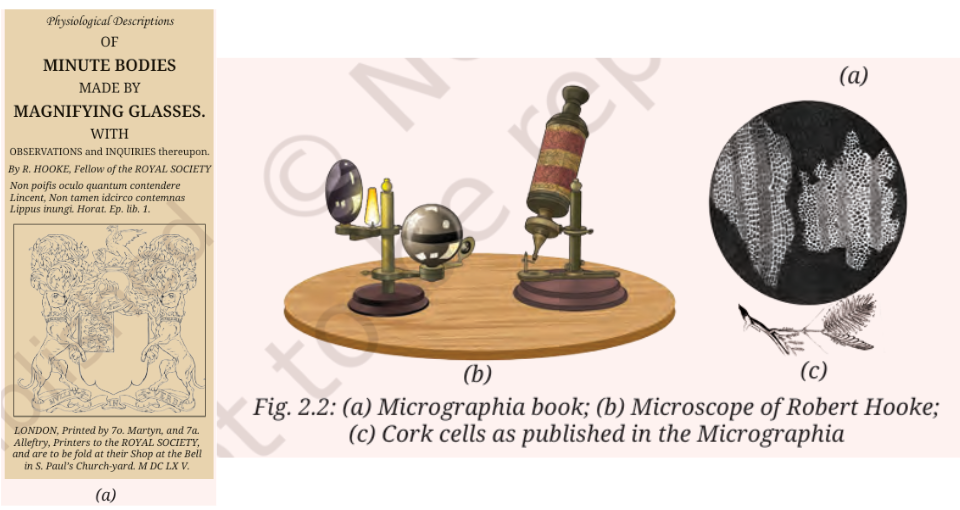
Robert Hooke (1665)
The Birth of Cell Biology
- Published "Micrographia" - a groundbreaking book
- He was both a careful observer and skilled artist
- His microscope magnified objects 200-300 times
- Observed cork slice and saw many small, empty spaces
- These compartments reminded him of honeycomb
- First used the word "cell" in science to describe basic unit of life
Antonie van Leeuwenhoek (1660s)
Father of Microbiology
- Dutch scientist who made better lenses
- Built more powerful microscopes
- First person to clearly see and describe tiny living things
- Observed bacteria and blood cells for the first time
- His discoveries opened the door to microbiology
🏗️ What is a Cell?
Cell: The cell is the basic structural and functional unit of life.
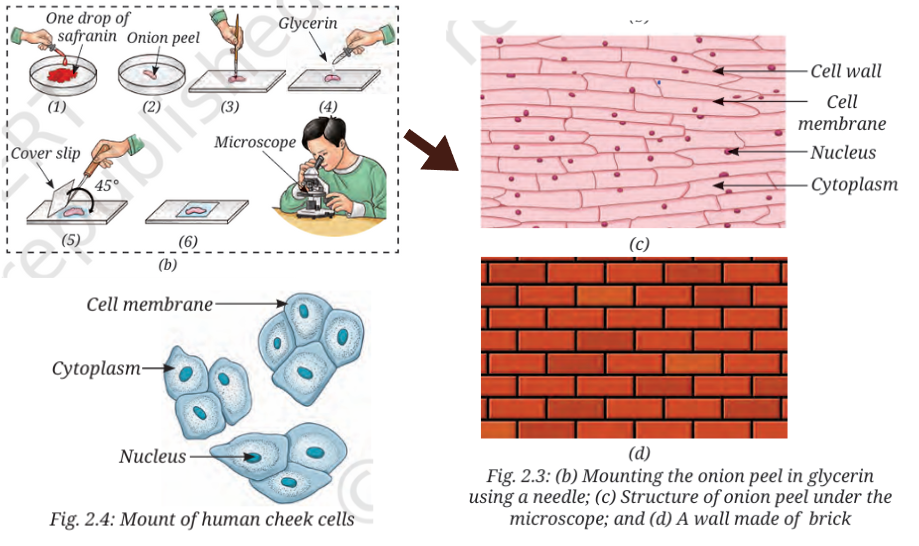
Just as bricks form a wall, cells form the body of living organisms.
All plants and animals are made up of cells.
When observed under a microscope:
- Onion peel cells: Appear rectangular and closely packed, showing plant cell structure.
- Cheek cells: Appear polygonal, forming the inner lining of our mouth, showing animal cell structure.
🔑 Basic Components of a Cell
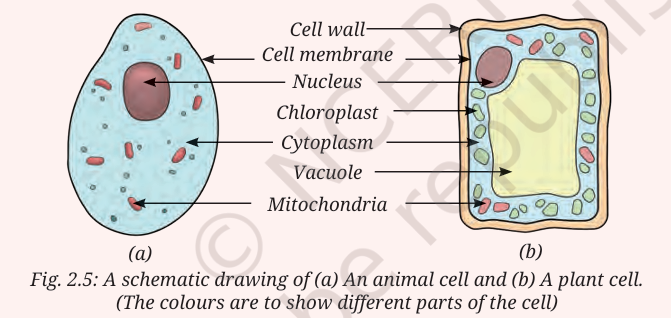
- Cell Membrane:
Definition: A thin, flexible boundary around the cell that gives it shape and protection.
Functions:
- Separates one cell from another
- Allows useful materials to enter
- Removes waste materials
- Cytoplasm:
Definition: Jelly-like fluid inside the cell between the membrane and nucleus.
Functions:
- Holds organelles (cell parts)
- Contains nutrients like proteins, fats, and minerals
- Site of most life processes
- Nucleus:
Definition: A round, membrane-covered structure that acts as the control center of the cell.
Functions:
- Controls all cell activities
- Regulates growth and reproduction
- Contains genetic material (DNA)
- Cell Wall (Plants only):
Definition: A thick, rigid outer covering present only in plant cells.
Functions:
- Provides rigidity and strength
- Gives firm shape to the plant body
- Keeps plant cells arranged compactly
🌱 Advanced Plant Cell Structures
- Plastids: Small structures found only in plants; they store food or help in photosynthesis.
- Chloroplasts: A special type of plastid that contains chlorophyll, which captures sunlight for photosynthesis.
- Vacuole: Large, fluid-filled space in plant cells that stores water, food, and waste, and helps maintain shape.
📊 Plant Cell vs. Animal Cell
| Component |
Plant Cell |
Animal Cell |
| Cell Wall |
Present – provides rigidity |
Absent |
| Chloroplasts |
Present – for photosynthesis |
Absent |
| Vacuole |
Large – for storage and support |
Small or absent |
| Cell Membrane |
Present |
Present |
| Nucleus |
Present |
Present |
| Cytoplasm |
Present |
Present |
🎨 Why Cells Have Different Shapes - Form Follows Function
The unique shape, size, and structure of cells help them carry out their specific functions. Different cells have different shapes based on the work they perform.
Examples of Cell Shape-Function Relationship:
1. Human Cheek Cells
- Shape: Thin and flat
- Function: Form protective lining on inner cheek surface
- Why this shape: Flat shape provides effective barrier protection
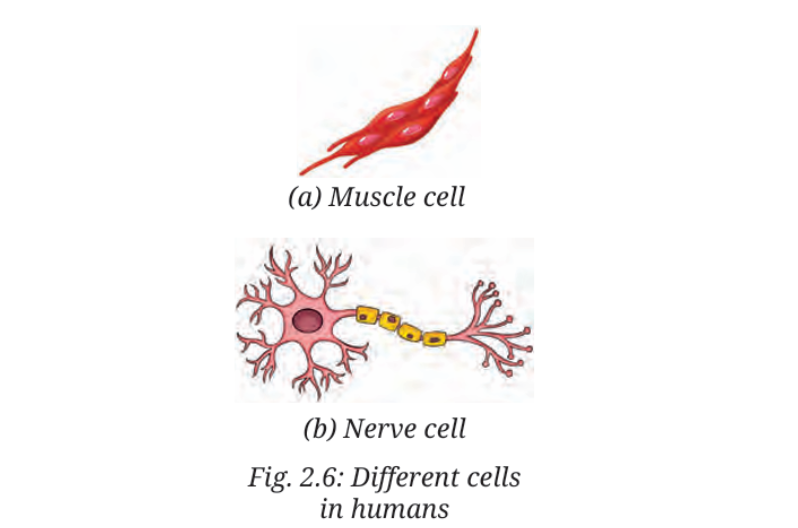
2. Nerve Cells (Neurons)
- Shape: Very long with branched structure
- Function: Carry messages throughout the body
- Why this shape: Length helps reach different body parts; branches enable quick message transmission
3. Muscle Cells
- Shape: Spindle-shaped (thick in middle, pointed at ends)
- Function: Contract and relax for movement
- Why this shape: Flexible shape allows contraction in wave-like manner
Plant Cell Variations:
- Rectangular cells: Provide structural support
- Elongated cells: Form tissues for flexibility
- Tube-like cells: Form long tubes for water transport throughout plant
Digestive System Example:
How Different Cell Types Work Together:
- Food pipe muscle cells: Contract and relax in waves to push food down
- Stomach muscle cells: Help churn and mix food
- Stomach lining cells: Produce digestive juices and acid
All these specialized cells work together to make digestion possible!
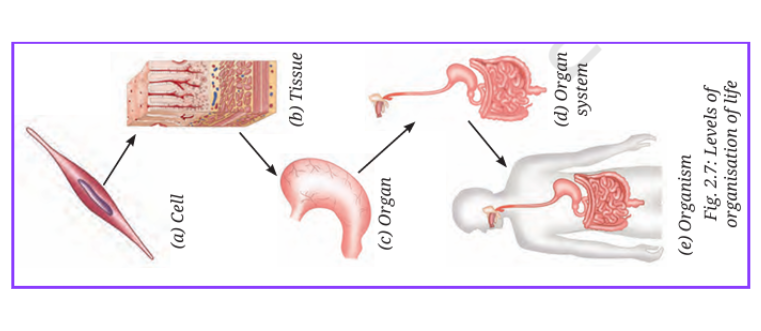
📊 Levels of Organization in Living Organisms
The body of a living organism is organized in a complex, hierarchical way. Just like a building is constructed from bricks, living organisms are built from cells in an organized manner.
The Organization Hierarchy:
Cell → Tissue → Organ → Organ System → Organism
Detailed Explanation:
1. Cell (Basic Unit)
- Smallest functional unit of life
- Like a single brick in a wall
- Performs basic life functions
2. Tissue (Group of Similar Cells)
- Collection of similar cells working together
- Example: Muscle tissue made of muscle cells
- Performs specific function as a group
3. Organ (Different Tissues Together)
- Different types of tissues organized together
- Example: Heart (muscle tissue + nerve tissue + connective tissue)
- Performs complex functions
4. Organ System (Multiple Organs)
- Several organs working together
- Example: Digestive system (mouth + stomach + intestines + liver)
- Performs major body functions
5. Organism (Complete Living Being)
- All organ systems working together
- Example: Complete plant or animal
- Can survive independently
Amazing Fact!
The life of complex living organisms begins with a single cell - the 'egg'. This single cell has the amazing ability to divide repeatedly to form a complete living being made up of billions of cells. Such organisms are called multicellular organisms.
World's Largest Single Cell
The yolk (yellow part) of an ostrich egg is the largest known single cell in the living world, measuring about 130-170 mm in diameter!
🦠 Introduction to Microorganisms
Microorganisms (Microbes): Tiny living organisms that are so small they cannot be seen with the naked eye and usually require a microscope for observation.
(Micro = very small, Organisms = living beings)
📌 Classification by Cell Number:
- Unicellular: Made up of a single cell
(Examples: Bacteria, Amoeba)
- Multicellular: Composed of many cells
(Examples: Some fungi, algae)
🌍 Where Are They Found?
Microorganisms exist almost everywhere in nature:
- Air
- Water (rivers, ponds, oceans)
- Soil and soil suspension
- In food items
- Inside our bodies (especially gut)
- On plant surfaces (leaves, stems, roots)
- Extreme environments (hot springs, snow-cold zones)
🔍 Observation Tools:
- Microscope: Traditional tool, magnifies 100–400 times
- Foldscope: Low-cost, paper-based microscope accessible for all
- Electron Microscope: High-power microscope, magnifies up to 1,000,000 times
🧬 Types of Microorganisms – Detailed Classification
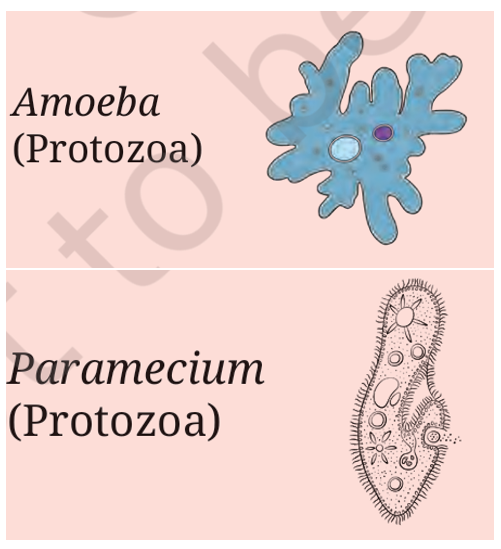
1. Protozoa (Animal-like Microorganisms)
Protozoa are simple, single-celled organisms that often behave like tiny animals. They can move and feed actively.
Amoeba:
- Shape: Irregular and constantly changing
- Movement: By pseudopodia (extensions of the cell body)
- Habitat: Ponds, lakes, moist soil
- Special Feature: Engulfs food using pseudopodia
Paramecium:
- Shape: Slipper-shaped
- Movement: Uses tiny hair-like structures called cilia
- Habitat: Fresh water
- Special Feature: Cilia also help in pushing food into its mouth-like opening
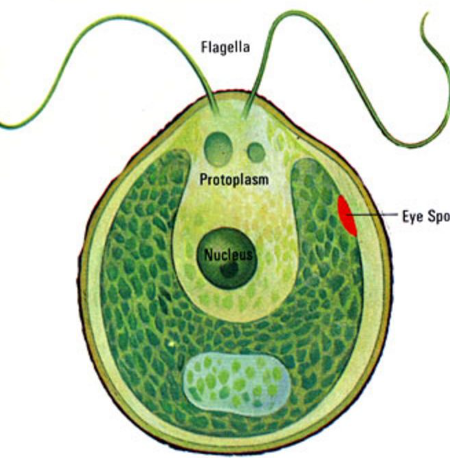
2. Algae (Plant-like Microorganisms)
Algae are green microbes that can make their own food through photosynthesis. They are important producers in aquatic ecosystems.
- Structure: Can be single-celled (Chlamydomonas) or multicellular (Spirogyra)
- Color: Green due to chlorophyll pigment
- Nutrition: Autotrophic (photosynthesis)
- Importance: Produce oxygen and serve as food for aquatic animals
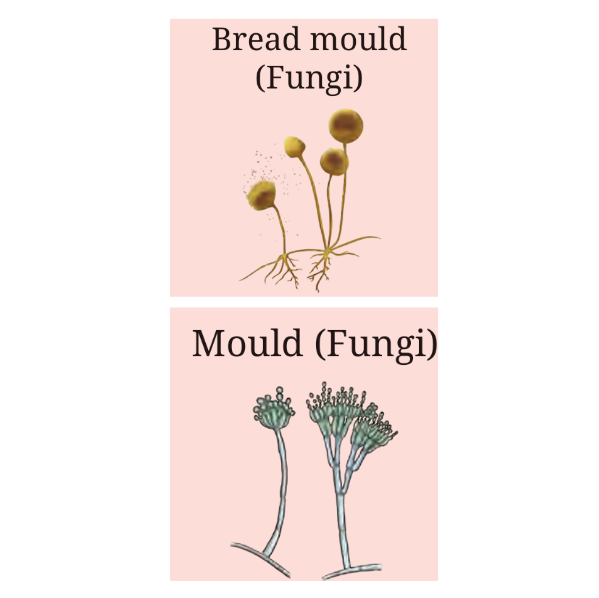
3. Fungi
Fungi are non-green organisms that feed on dead or decaying matter. They do not have chlorophyll and cannot make their own food.
Bread Mold:
- Structure: Thread-like structures called hyphae
- Nutrition: Saprophytic (feeds on dead matter)
- Special Feature: Produces spores for reproduction
Other Examples:
- Mushrooms and yeast
- Found in soil, food, and decaying matter
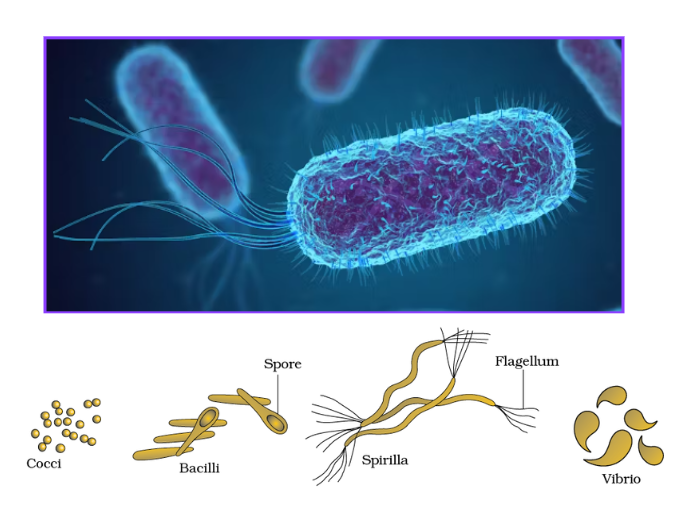
4. Bacteria
Bacteria are single-celled organisms found everywhere — soil, water, air, and even inside our bodies.
- Shapes: Spherical (cocci), Rod-shaped (bacilli), Spiral, Comma-shaped
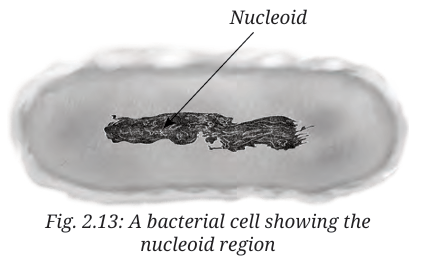
- Cell Structure: No true nucleus, only nucleoid region
- Movement: Some move using a long tail-like structure called flagellum
- Importance: Some are helpful (nitrogen fixation, digestion), others cause diseases
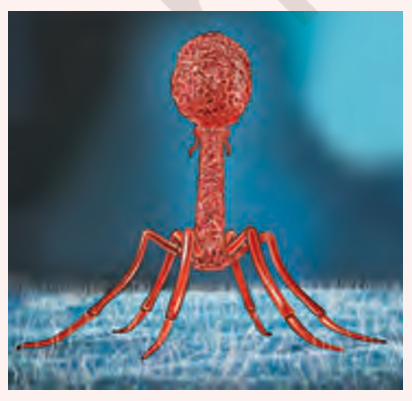
5. Viruses
Viruses are the smallest microbes and are unique because they are neither fully living nor fully non-living.
- Structure: Tiny particles without cell structure
- Reproduction: Only inside a living host cell
- Hosts: Infect plants, animals, bacteria (bacteriophages)
- Effect: Cause diseases like flu, measles, COVID-19
How Are We Connected to Microbes?
Microorganisms are present all around us – in soil, water, air, and even on the food we eat.
They can grow on the surfaces of fruits, leaves, stems, roots, and other parts of plants.
Some microbes are so adaptable that they survive in extreme conditions such as hot springs,
snow-covered regions, and deep oceans. Even inside our own bodies, especially in the gut,
helpful microorganisms play a vital role in processes like digestion.
Since microbes are everywhere, they are closely connected to our daily lives in many ways.
Let us now explore their importance in the environment, food industry, and other fields.
🌍Key players in cleaning the environment
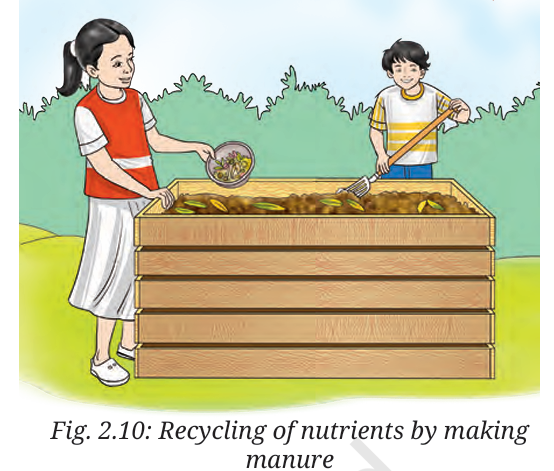
- Microorganisms (fungi and bacteria) decompose dead plants and animals.
- They break down complex waste into simple nutrients (manure).
- Manure enriches soil fertility and helps crops grow better.
- Thus, microbes recycle nutrients and maintain balance in nature.
Examples:
- Rotting leaves and food wastes → decomposed into nutrient-rich manure.
- Bacteria and fungi act as natural cleaners of our surroundings.
- Animal waste (like dung) also decomposed by microbes.
Microbes as a Source of Biogas
Many bacteria and fungi can live without oxygen (anaerobic). They decompose plant and animal waste to release a mixture of gases called biogas.
- Main gas released: Methane
- Other gases: Carbon dioxide and small amounts of others
- Biogas is used as a fuel for cooking, heating, electricity, and even vehicles
🍞 Microorganisms and Food Production
Microorganisms play vital roles in food preparation and processing. Let's explore how these tiny helpers work in our kitchens.
1. Role of Yeast in Food
What is Yeast?
- A type of microorganism belonging to fungi group
- Single-celled organism (unicellular fungus)
- Grows well in warm conditions
- Feeds on sugar and releases energy
How Yeast Works in Bread Making:
The Fermentation Process:
- Yeast feeds on sugar in the dough
- During respiration, it breaks down sugar
- Releases carbon dioxide gas as a byproduct
- CO₂ forms bubbles that make dough rise and become fluffy
- Also produces a small amount of alcohol (which evaporates during baking)
- Gives bread its characteristic smell and soft texture
Word Equation:
Glucose → Alcohol + Carbon dioxide
Other Uses of Yeast:
- Making cakes and pastries
- Preparation of idli and dosa batter (with Lactobacillus bacteria)
- Making bhatura dough
2. Role of Bacteria in Food
Lactobacillus Bacteria:
- Converts milk into curd by feeding on lactose (milk sugar)
- Produces lactic acid, which makes curd sour and thick
- Works best in warm conditions
Curd Formation Process:
- Lactobacillus bacteria multiply in milk
- They ferment lactose into lactic acid
- Lactic acid thickens milk and gives curd its taste
🌾 Microorganisms in Agriculture
Rhizobium Bacteria – Nature’s Fertilizer
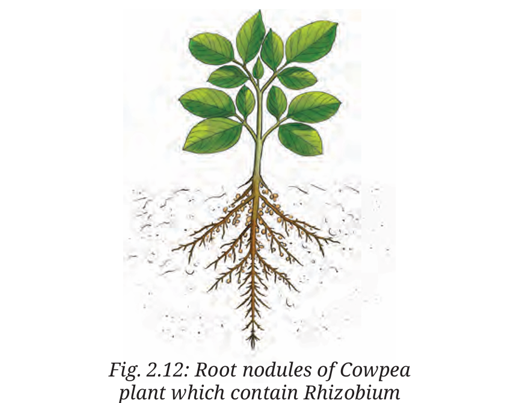
Rhizobium is a special bacteria that lives inside the roots of legume plants (like beans, peas, lentils, and cowpea). It forms swollen parts called root nodules and lives in a symbiotic relationship with the plant.
How Rhizobium Helps (Nitrogen Fixation):
- Traps nitrogen gas from the air
- Converts it into nitrogen compounds usable by plants
- Supplies essential nutrition for plant growth
- Enriches soil with nitrogen naturally
Benefits:
- Improves growth of legume crops without chemical fertilizers
- Increases soil fertility for the next crop
- Reduces cost of farming (less fertilizer needed)
- Promotes sustainable and eco-friendly agriculture
🌊 Amazing Microalgae: Tiny Helpers in Water
Microalgae: Microscopic plant-like organisms that live in water, soil, air, and even on trees. They make their own food using sunlight through photosynthesis.
Where Microalgae Live:
- Water bodies (rivers, lakes, oceans)
- Soil
- Air
- On tree surfaces
- Various aquatic environments
Importance of Microalgae:
1. Oxygen Production
- Produce more than half of Earth's oxygen supply
- Essential for maintaining oxygen balance
- Support all aerobic life on Earth
2. Food Source
- Rich in nutrients
- Serve as food for many aquatic animals
- Form base of aquatic food chains
3. Human Applications
- Used as health supplements and medicines
- Examples: Spirulina, Chlorella, Diatoms
- Help in water cleaning processes
- Used to make biofuel
Spirulina - The Superfood
Why Spirulina is Called Superfood:
- High protein content: More than 60% of body weight
- Vitamin B12: Essential vitamin, especially for vegetarians
- Low fat and sugar: Healthy nutritional profile
- Rich in minerals: Contains essential nutrients
- Antioxidants: Helps fight diseases
Conservation of Microalgae:
Threats:
- Pollution
- Climate change
- Habitat destruction
Why Conservation is Important:
- Protect environment
- Maintain oxygen balance
- Ensure food security
- Support livelihood development
🧬 Why is Cell Considered the Basic Unit of Life?
The cell is considered the basic unit of life because all living organisms are made up of cells, and cells contain all the components necessary for life processes.
Key Reasons:
1. Universal Presence
- Bodies of all plants and animals are made up of cells
- Even microorganisms are made of one or more cells
- No living organism exists without cells
2. Functional Independence
- Single cell can carry out all life processes
- Contains components for survival and reproduction
- Can perform metabolism, growth, and response to environment
Cell Structure in Different Organisms:
Common Features:
- All cells surrounded by cell membrane
- All contain cytoplasm
- Most have genetic material
Special Features:
- Fungi cells: Have cell wall but no chloroplasts
- Bacterial cells: No well-defined nucleus, have nucleoid region
- Plant cells: Have cell wall and chloroplasts
- Animal cells: No cell wall, small or no vacuoles
Advanced Microscopy:
Levels of Magnification:
- Light microscope: 100-400x magnification
- Electron microscope: Up to 10,00,000x magnification
- High magnification reveals more cellular structures
- Helps understand detailed cell organization
📝 Chapter Summary - Key Points
Important Points to Remember:
- Cell: Basic unit of life, discovered by Robert Hooke
- Microorganisms: Small organisms not visible to naked eye
- Types: Bacteria, protozoa, fungi, algae, viruses
- Cell types: Unicellular or multicellular
- Habitats: Found everywhere - water, soil, air, inside organisms
- Benefits: Environmental cleaning, food production, agriculture
- Cell structure: Cell membrane, cytoplasm, nucleus
- Plant vs Animal cells: Plants have cell wall and chloroplasts
- Organization levels: Cell → Tissue → Organ → Organ System → Organism
- Shape-function relationship: Cell shape matches its function
- Microscopes: Tools to observe microscopic world
- Applications: Bread making, curd formation, nitrogen fixation