Introduction to Forces
Forces are fundamental to our existence and daily experiences. From the moment we wake up and get out of bed to the time we lie down to sleep, we are constantly applying and experiencing forces. A force is essentially a push or pull that can cause an object to move, stop, change direction, or change shape.
Forces always involve an interaction between two objects. When you push a table, your hand (one object) applies force to the table (another object). This interaction is mutual - when you push on the table, the table also pushes back on your hand with equal force (Newton's Third Law of Motion). The effects of forces are visible all around us in various forms and actions, from the gentle breeze moving leaves to the powerful engines propelling rockets into space.
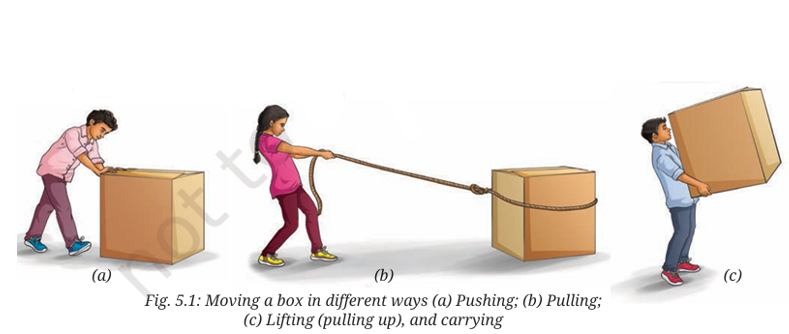
Effects of Forces
Forces can produce various effects on objects. Understanding these effects helps us comprehend how objects behave in different situations and is crucial for explaining everyday phenomena as well as complex engineering applications.
A stationary object starts moving when a force is applied.
Example: Pushing a parked car to make it move.A moving object can be brought to rest by applying force.
Example: Catching a flying cricket ball.A moving object can speed up or slow down when force is applied.
Examples: Pressing the accelerator pedal in a car (increase speed), applying brakes while cycling (decrease speed).The path of a moving object can be altered by applying force.
Example: Hitting a tennis ball with a racket during a match.The physical form of an object can be modified.
Example: Squeezing a piece of clay or dough.Forces can create multiple changes at once.
Example: When a batsman hits a ball, its speed and direction both change.Balanced Forces
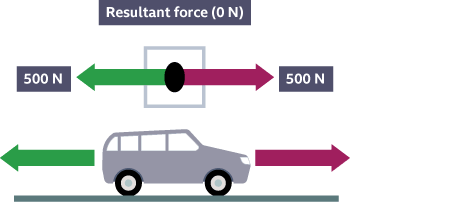
When multiple forces act on an object but cancel each other out, the object is in equilibrium. In this state, there is no net force acting on the object, so its motion doesn't change. If the object is at rest, it remains at rest; if it's moving, it continues moving at constant velocity. This is a direct consequence of Newton's First Law of Motion.
Types of Forces
Forces can be categorized into - Contact and Non Contact Forces based on whether they require physical contact between objects or can act at a distance.
Contact Forces
Contact forces are those that require physical contact between two objects. These forces act only when there is direct or indirect physical contact. They are the most familiar types of forces in our everyday experiences.
Characteristics and Applications
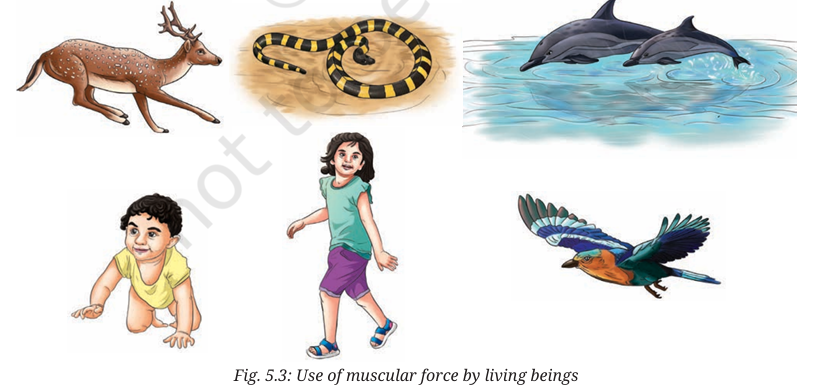
- Result of muscle action in living beings through biochemical energy conversion
- Used for voluntary movements like walking, running, lifting, pushing
- Animals use muscular force for locomotion, feeding, and defense mechanisms
- Humans have historically domesticated animals to harness their muscular force for agriculture, transportation, and other tasks
- Muscle efficiency varies across species, with some insects capable of lifting many times their body weight
Muscular force plays crucial roles within our bodies beyond voluntary movement. Involuntary muscular actions help us chew food, push food through the digestive system (peristalsis), and the contraction and expansion of heart muscles that circulate blood throughout our bodies. The efficiency of muscular force is influenced by factors like nutrition, training, and physiological conditions.
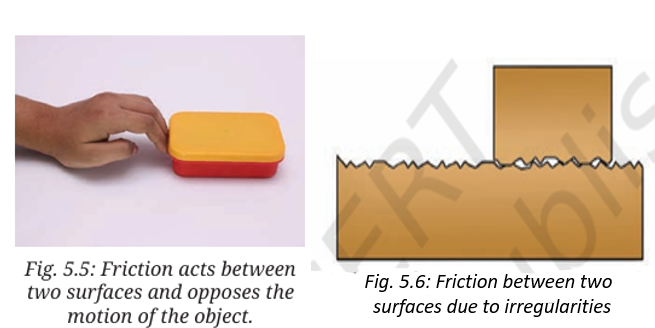
A ball rolling on a flat ground stops after some time, and a bicycle slows down if we stop pedalling. An object placed on different surfaces travels different distances before stopping — on a rough road it stops sooner than on a smooth one. These everyday observations show that a resisting force between surfaces brings moving objects to rest.
Key Points
- Nature: Friction arises from microscopic irregularities of surfaces that interlock and from molecular adhesion where surfaces meet.
- Direction: It always acts opposite to the direction of motion or attempted motion.
- Dependence: Friction depends on the nature of the surfaces in contact and the normal force (how hard the surfaces are pressed together).
- Surface effect: Rough surfaces usually produce greater friction; even apparently smooth surfaces have tiny irregularities that cause friction.
- Types: Static friction acts when motion is just about to start; kinetic (sliding) friction acts when motion is occurring.
- Friction in fluids: Air and water also exert friction (drag) on moving objects; this is why vehicles and aircraft are streamlined to reduce resistance.
- Useful effects: Enables walking, gripping, writing with a pen, and braking in vehicles.
- Harmful effects: Causes wear and tear, energy loss as heat, and increases fuel consumption unless reduced where needed.
- Reduction methods: Lubricants, polishing, using wheels or ball bearings, and streamlining reduce friction or fluid drag.
Non-Contact Forces
Non-contact forces can act between objects without any physical contact. These forces can act through empty space and are fundamental forces of nature that govern interactions at both microscopic and macroscopic scales.
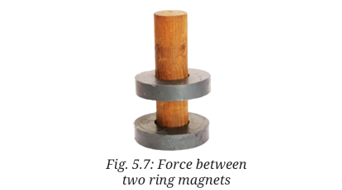
A magnet is a material that can attract certain substances such as iron, nickel, and cobalt. Every magnet has two poles — the north pole and the south pole. The force exerted by a magnet on magnetic materials or on another magnet is called magnetic force. It is a non-contact force that acts at a distance.
Key Points
- Magnetic force acts without physical contact, similar to electrostatic force and gravity.
- Every magnet has two poles: north and south.
- Like poles repel each other, while unlike poles attract each other.
- The magnetic force is strongest near the poles of a magnet.
- Magnetic field lines represent the region around a magnet where magnetic force can be experienced.
- Earth itself behaves like a huge magnet, with its magnetic field guiding a freely suspended compass needle.
- Applications: used in compasses, electric motors, generators, magnetic levitation (Maglev) trains, and data storage devices.
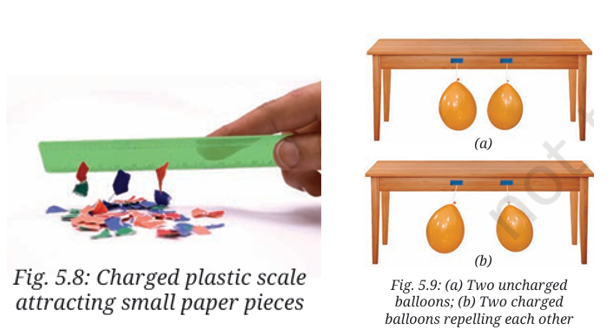
When certain materials are rubbed together, electrons are transferred from one object to another. This creates an imbalance of charges, making one object positively charged and the other negatively charged. The charges thus produced are called static charges as they do not move by themselves. An object that has static charges is said to be a charged object.
Key Points
- There are two kinds of charges: positive and negative.
- Like charges repel each other, while unlike charges attract each other.
- Electrostatic force is produced mainly by friction between certain materials (e.g., plastic, wool, silk, glass).
- A charged object can attract small uncharged objects such as paper bits or hair.
- Electrostatic force is much stronger than gravitational force but usually balanced in everyday matter.
- It follows the inverse-square law — the force becomes stronger when objects are closer.
- Electrostatic phenomena are responsible for natural events like lightning and are applied in devices such as photocopiers, air purifiers, and electrostatic paint sprayers.
A Step Further
When charges move, they form an electric current. This current is used to light bulbs, produce heat, and generate magnetic effects in electrical devices.
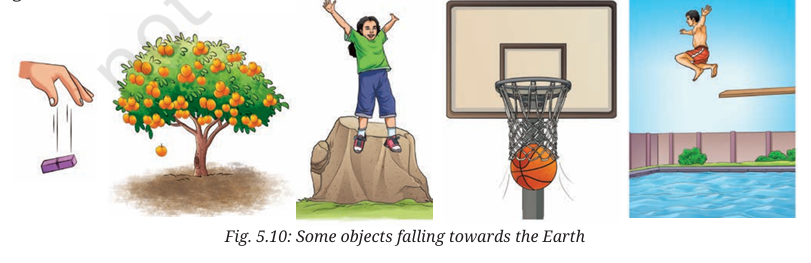
Objects thrown upwards or dropped from a height always move back towards the Earth. This happens because the Earth pulls all objects towards its center. This pulling effect is due to the force of gravity.
Key Points
- Gravity always pulls objects towards the Earth; it never repels.
- When an object is thrown upwards, it slows down, stops, and then falls back due to gravity.
- When dropped from a height, objects fall vertically downward with increasing speed.
- Gravitational force gives objects their weight (weight = mass × gravitational acceleration).
- It is weaker than electrostatic and magnetic forces but acts on all objects with mass.
- Applications: responsible for rainfall, river flow, tides, motion of planets, and keeping everything anchored to Earth.
Weight and Its Measurement
Weight is often confused with mass, but they are fundamentally different concepts. Mass is an intrinsic property of an object that remains constant regardless of location, while weight is the gravitational force acting on that mass and varies with the strength of the gravitational field.
The Relationship Between Mass and Weight
The weight of an object is related to its mass by the equation:
Weight Formula
W = m × g
Where:
W = weight (in newtons, N)
m = mass (in kilograms, kg)
g = acceleration due to gravity (approximately 9.8 m/s² on Earth's surface)
This relationship shows that weight is proportional to mass, with the acceleration due to gravity serving as the proportionality constant. On Earth, a 1 kg mass has a weight of approximately 9.8 N, often rounded to 10 N for simplicity in educational contexts.
Measuring Weight with a Spring Balance
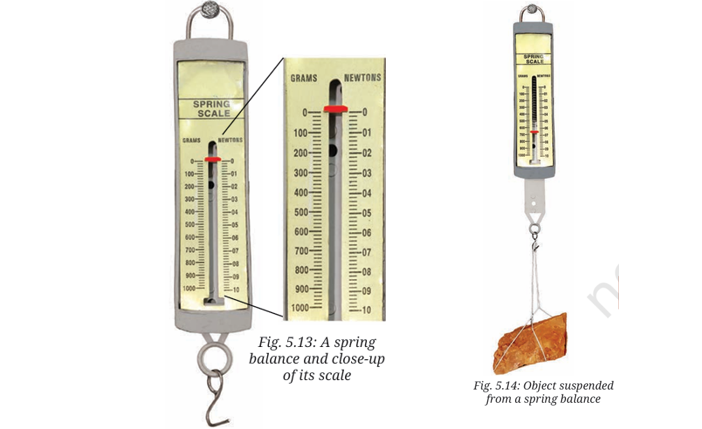
A spring balance is a device used to measure weight. It works on Hooke's Law, which states that the extension of an elastic material is proportional to the force applied to it.
Principles of Spring Balance Operation
Difference Between Mass and Weight
| Property | Mass | Weight |
|---|---|---|
| Definition | Amount of matter in an object | Force of gravity on an object |
| SI Unit | Kilogram (kg) | Newton (N) |
| Variation with Location | Constant everywhere | Varies with gravitational field strength |
| Measuring Instrument | Beam balance, mass scale | Spring balance |
| Nature | Scalar quantity (magnitude only) | Vector quantity (magnitude and direction) |
| Dependence on Gravity | Independent | Directly proportional |
| Zero Condition | Never zero | Zero in absence of gravity |
Weight on Different Celestial Bodies
The weight of an object varies on different planets and moons due to differences in gravitational pull, while its mass remains constant. This variation occurs because the acceleration due to gravity (g) differs based on the celestial body's mass and radius.
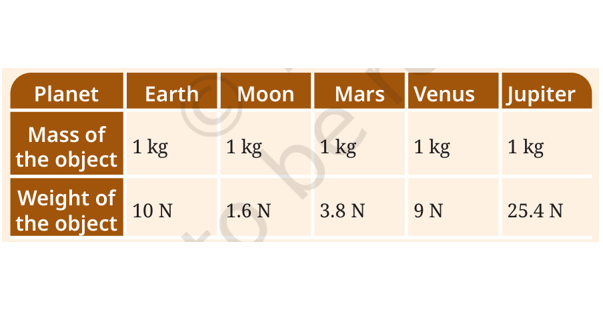
These differences have significant implications for space exploration. Astronauts on the Moon can jump much higher and carry heavier equipment relative to their Earth capabilities due to the reduced gravity. Conversely, the high gravity on Jupiter would make movement extremely difficult for humans.
Floating and Sinking
When objects are placed in fluids (liquids or gases), they may float or sink depending on the balance between gravitational force and buoyant force. This phenomenon is governed by Archimedes' Principle, which has applications ranging from ship design to understanding biological systems.
The Science Behind Floating and Sinking
The behavior of objects in fluids is determined by the relationship between two forces:
Forces Acting on Immersed Objects
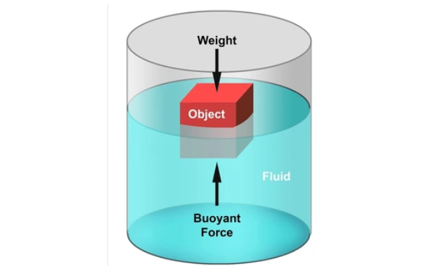
An object will:
- Sink if the gravitational force is greater than the buoyant force (object's density > fluid's density)
- Float submerged if the gravitational force equals the buoyant force (object's density = fluid's density)
- Float partially above surface if the buoyant force is greater than the gravitational force (object's density < fluid's density)
Archimedes' Principle
Archimedes' Principle states: "Any object, wholly or partially immersed in a fluid, is buoyed up by a force equal to the weight of the fluid displaced by the object."
This principle explains why:
- Heavy ships float on water (they displace a large volume of water, creating substantial buoyant force)
- Helium balloons rise in air (the buoyant force of the displaced air exceeds the weight of the balloon)
- Some rocks like pumice float on water (they have low density due to air pockets from volcanic formation)
- It's easier to lift objects underwater (the buoyant force reduces the apparent weight)
Applications of Buoyancy
Understanding buoyancy has led to numerous practical applications:
Real-World Applications
Density and Buoyancy
The key factor determining whether an object floats or sinks is the relationship between its density and the density of the fluid:
Density Relationship
If object density > fluid density → Object sinks
If object density = fluid density → Object remains suspended
If object density < fluid density → Object floats
Density (ρ) is calculated as mass divided by volume (ρ = m/V). This is why large ships can float—they have shapes that displace a large volume of water, and their overall density (including air spaces) is less than that of water.
Summary of Key Concepts
Core Principles of Forces
🧠 Practice Questions
Test your understanding with these practice questions. Click "Show Answer" to reveal the solutions.
Explanation: Magnetic force is a non-contact force as magnets can attract or repel without touching.
Explanation: Newton (N) is the SI unit of force, named after Sir Isaac Newton.
It is difficult to walk on wet, slippery surfaces because friction is greatly reduced. When surfaces are wet, a thin layer of water acts as a lubricant between our shoes and the ground, reducing the irregularities that normally create friction. The force involved is friction (or lack of sufficient friction). Without adequate friction, our feet cannot grip the surface properly, causing us to slip. This is why we need to be extra careful on wet floors, ice, or oily surfaces.
This happens because weight and mass are different quantities:
• Mass is the amount of matter in an object and remains constant
• Weight is the gravitational force acting on an object
The Moon has much weaker gravity than Earth (about 1/6th). So while the astronaut's mass stays the same, the gravitational pull (and hence weight) is much less on the Moon. For example, a 60 kg astronaut weighs 600 N on Earth but only 100 N on the Moon.
Explanation: Friction always acts in the opposite direction to the motion or attempted motion of an object.
- Change in motion: A force can start, stop, or change the direction of motion. Example: Kicking a football changes its motion.
- Change in shape: Forces can deform objects. Example: Squeezing a rubber ball changes its shape.
- Change in speed: Forces can increase or decrease speed. Example: Braking force slows down a moving car.
- Balance forces: Balanced forces keep objects stationary. Example: A book resting on a table has balanced forces.